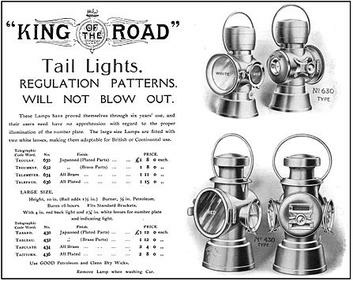
King of the Road

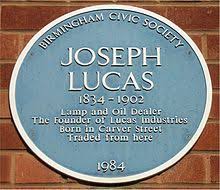
In the 1850’s, Joseph Lucas, a jobless father of six, sold paraffin oil from a barrow cart around the streets of Hockley. In 1860, he founded the firm that would become Lucas Industries. His 17-year-old son Harry joined the firm around 1872. At first it made general pressed metal merchandise, including plant pot holders, scoops and buckets, and later in 1875 lamps for ships. Joseph Lucas & Son was based in Little King Street from 1882 and later Great King Street Birmingham.
Harry Lucas designed a hub lamp for use in a high bicycle in 1879 and named the oil lamp "King of the Road". This name would come to be associated with the manufactured products of Lucas Companies, into the present day. However, Lucas did not use the "King of the Road" epithet for every lamp manufactured. They used this name on only their most prestigious and usually highest priced lamps and goods. This naming format would last until the 1920’s when the "King of the Road" wording was pressed into the outer edge of the small "lion and torch" button motifs that frequently decorated the tops of both bicycle and motor-car lamps. The public were encouraged by Lucas to refer to every Lucas lamp as a "King of the Road", but strictly speaking, this is quite wrong, as most lamps throughout the 20th century possessed either a name, a number, or both. Joseph and Harry Lucas formed a joint stock corporation with the New Departure Bell Co., of America in 1896, so that Lucas designed bicycle lamps could be manufactured in America to avoid import duties.
In 1902, what had by then become Joseph Lucas Ltd, incorporated in 1898, started making automotive electrical components such as magnetos, alternators, windscreen wipers, horns, lighting, wiring and starter motors.[1] The company started its main growth in 1914 with a contract to supply Morris Motors Limited with electrical equipment. During the First World War Lucas made shells and fuses, as well as electrical equipment for military vehicles. Up until the early 1970’s, Lucas was the principal supplier to British manufacturers (such as BSA, Norton and Triumph) of magnetos, dynamos, alternators, switches and other electrical components.
After the First World War the firm expanded rapidly, branching out into products such as braking systems and diesel systems for the automotive industry and hydraulic actuators and electronic engine control systems for the aerospace industry. In 1926 they gained an exclusive contract with Austin. Around 1930, Lucas and Smiths established a trading agreement to avoid competition in each other's markets. During the 1920’s and 1930’s Lucas grew rapidly by taking over a number of their competitors such as Rotax and C.A.Vandervell (CAV). During WWII Lucas were engaged by Rover to work on the combustion and fuel systems for the Whittle jet engine project making the burners. This came about because of their experience of sheet metal manufacture and CAV for the pumps and injectors. In the 1950’s (exact dates needed) they started a semiconductor manufacturing plant to make rectifiers and transistors.
The King of the Road name returned in 2013 as Lucas Electrical reintroduced a range of bicycle lighting to the UK.
The name was reserved for the Lucas Electrical's premium LED bike lights.